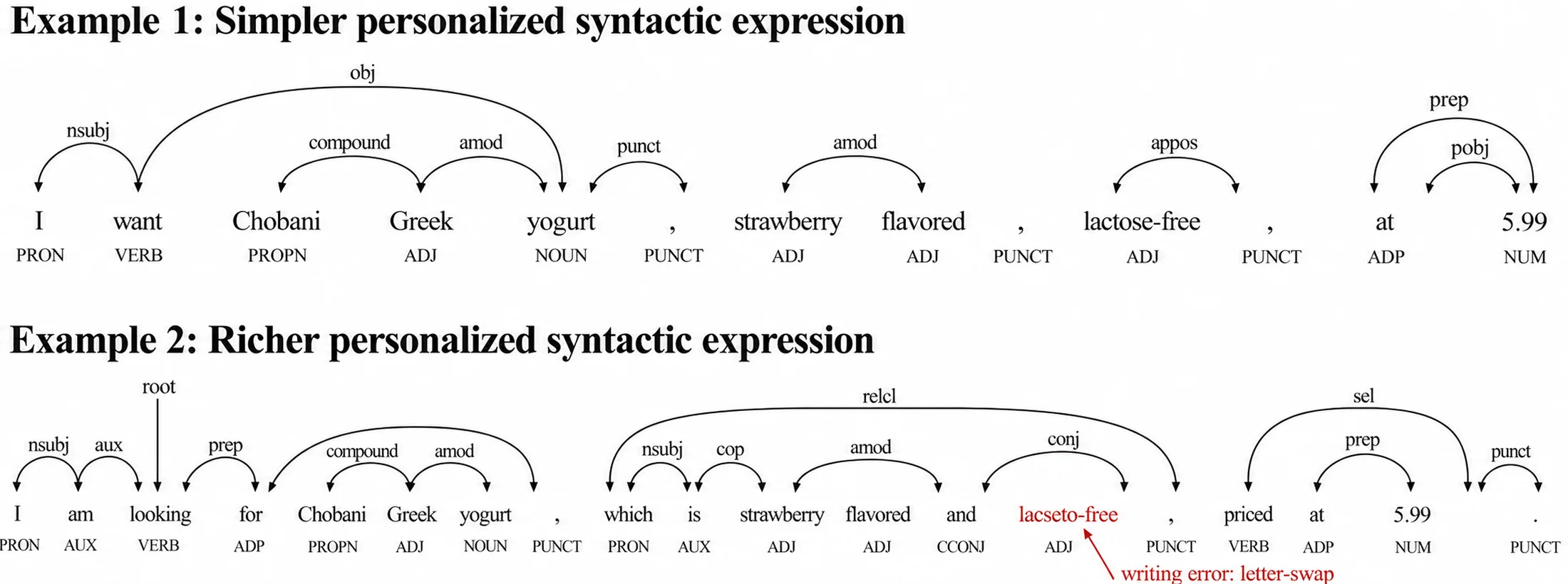
“I want Chobani Greek yogurt, strawberry flavored, lactose-free, at 5.99.”
Direct attribute organization. Same five core terms, same frequencies.
ACM Transactions on Information Systems · Manuscript
Evaluating retrieval robustness to personalized user expression differences
1 Monash University · 2 University of Queensland · 3 Southeast University
Corresponding author: Wenyu Liang · wlia0047@student.monash.edu
Target product Chobani Greek yogurt · strawberry · lactose-free · $5.99
“I want Chobani Greek yogurt, strawberry flavored, lactose-free, at 5.99.”
Direct attribute organization. Same five core terms, same frequencies.
“I am looking for Chobani Greek yogurt, which is strawberry flavored and lacseto-free, priced at 5.99.”
Letter swap from User B’s own error profile. Intent and retrieval target unchanged.
Two queries for the same product, differing only in syntactic organization and a user-specific writing error.
01The question
Personalized retrieval usually asks what a user wants. Preferences, interaction histories, and query intent all shape the answer. PQB asks a narrower, harder question: when the need is fixed, does the wording alone move the ranking?
Existing benchmarks rarely make this test possible. Personalized datasets vary the need itself; natural query logs lack stable identities and long-term expression histories; and intent-matched query pairs are almost never available. As a result, a system’s sensitivity to how users write is rarely separated from its sensitivity to what users want.
When users express the same retrieval need differently, how robust are retrieval systems to personalized expression differences?
Central question · Section 1
PQB isolates expression as an independent variable. It models two complementary dimensions from each user’s real review history — how they organize a sentence, and which writing errors they characteristically make — then constructs queries that hold the product, its core attributes, the five core retrieval terms, and their frequencies fixed.
02Abstract
Existing personalized information retrieval methods mainly model differences in user needs through user preferences and query intent, while paying little attention to how different users express the same retrieval need. Real query data typically lack stable user identities, long-term expression histories, and intent-matched counterparts, which impedes systematic evaluation of the impact of personalized expression differences on retrieval outcomes. To this end, we propose PersonalQuery-Benchmark (PQB). PQB models personalized syntactic expression and personalized writing errors from users’ historical texts, constructs personalized syntactic expression queries and personalized writing-error queries, and validates benchmark quality through LLM assessment and independent human evaluation. PQB covers three Amazon product domains with 6,516 query instances, and is evaluated on five retrieval models representing lexical, learned sparse, dense bi-encoder, late-interaction, and hybrid architectures, plus two LLM-based ranking models. Results show that even when the information need is held fixed, personalized expression differences induce measurable ranking variation; different retrieval models exhibit clearly different sensitivities to syntactic variation and writing-error variation, while higher overall retrieval effectiveness does not necessarily correspond to stronger robustness against expression variation. PQB provides a new benchmark and evaluation framework for systematically studying personalized expression robustness. Code and dataset are available at github.com/cpxjazz123/PersonalQuery-Benchmark.
03Benchmark
PQB samples target products from three Amazon domains and links each to users with enough review history to model expression. The product side fixes the retrieval target; the user side supplies the syntax and the error habits.
Each benchmark row contains a target product a, a user u, and a query qu,a. When a valid writing-error variant survives generation, the row also carries the paired query q̃u,a. Across the three domains this yields 3,654 syntactic queries and 2,862 writing-error queries.
| Domain | Syntactic | Writing-error | Total | User profiles | Sentences |
|---|---|---|---|---|---|
| Baby Products | 398 | 298 | 696 | 273 | 13,650 |
| Musical Instruments | 742 | 573 | 1,315 | 487 | 24,350 |
| Video Games | 2,514 | 1,991 | 4,505 | 1,517 | 75,850 |
| Total | 3,654 | 2,862 | 6,516 | 2,277 | 113,850 |
Syntactic and writing-error counts sum to each domain’s total. User profiles are distinct within a domain and summed in the total.Source: Amazon Reviews 2023.
04Method
Every PQB example starts from a real product and a real user. Generation is constrained so that the retrieval target stays fixed; only the expression is allowed to vary.
Dependency 3-tuples, dependency 4-tuples, and POS trigrams form a 21,737-rule vocabulary. A same-product contrastive encoder maps each sentence to 16 dimensions, and a per-user rank-one-plus-diagonal Gaussian captures the user’s syntactic position and within-user spread.
GECToR and ERRANT recover character-level edits from review history. A user- and context-conditioned distribution over error mechanisms then drives constrained edits on the clean query, preserving the retrieval target and the core terms.
The pipeline separates product-side semantics from user-side expression evidence. Candidate queries are generated under product attributes, filtered for lexical and semantic validity, then matched to users through their fitted distributions.
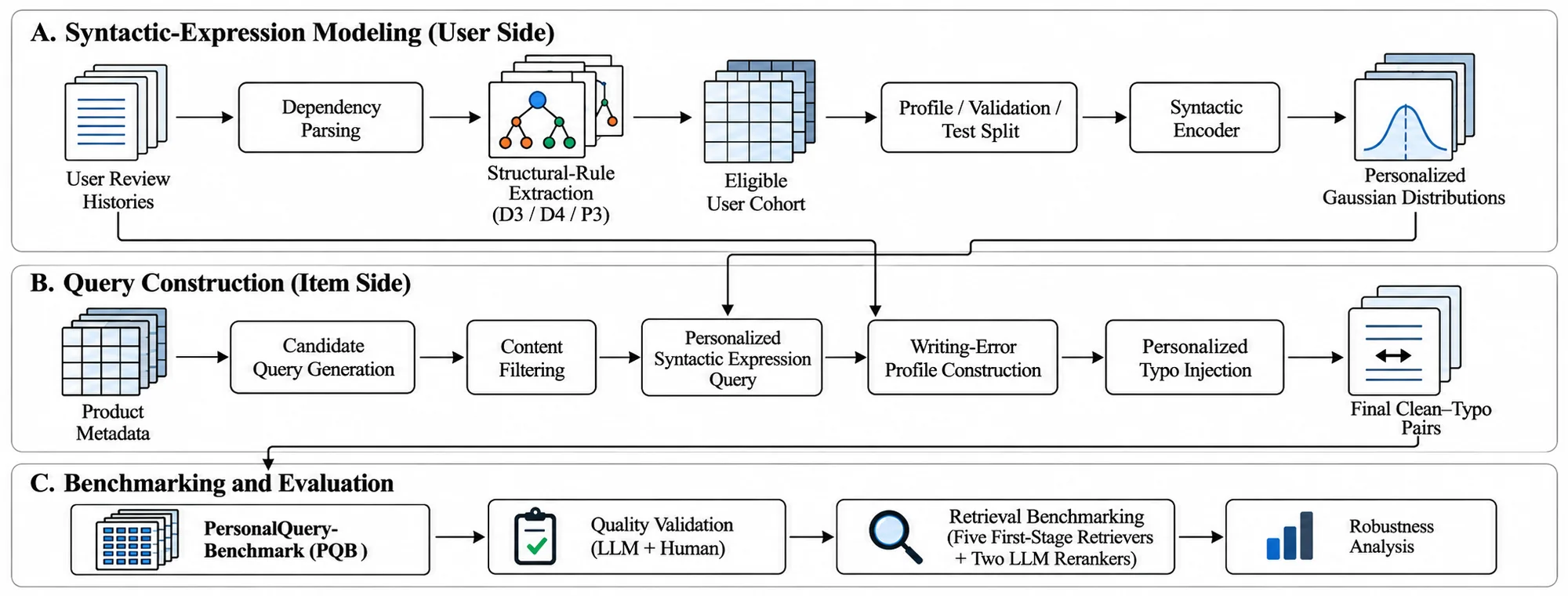
Merge title, description, and features into a retrieval document; select the main attributes as generation constraints.
Fit a syntactic Gaussian from structural rules and estimate a context-conditioned error profile from aligned edits.
Produce attribute-conditioned candidates; retain those inside the user’s acceptance region and outside the other user’s.
Build cross-user syntactic pairs at maximum distributional distance and within-user clean–error pairs.
05Results
Five first-stage retrievers and two LLM rerankers are evaluated on the same paired queries. All figures below are equal-weight averages over Baby Products, Musical Instruments, and Video Games; per-domain tables are in the paper.
Flip@K is the share of query pairs with different top-K hit status. Mean RRstd is the standard deviation of reciprocal rank within the top 200. Lower is more robust.
| Model | Flip@1 | Flip@5 | Flip@10 | Flip@20 | Mean RRstd |
|---|---|---|---|---|---|
| BM25 | 41.67% | 28.22% | 27.76% | 22.54% | 5.38% |
| SPLADE | 26.57% | 14.95% | 12.45% | 11.12% | 3.10% |
| GTE-base | 40.37% | 35.53% | 24.13% | 27.62% | 3.64% |
| BGE-M3 Hybrid | 36.32% | 21.32% | 19.18% | 18.97% | 4.31% |
| ColBERTv2 | 52.19% | 40.47% | 36.43% | 34.46% | 4.64% |
| Llama-3.1-8B | 42.04% | 31.62% | 27.76% | 21.27% | 6.33% |
| Qwen3-Reranker-8B | 43.25% | 28.74% | 24.86% | 21.60% | 6.63% |
lowest value (most robust) highest value (most sensitive)
Every system moves. Flip@1 ranges from 26.57% for SPLADE to 52.19% for ColBERTv2, even though the target product, five core terms, and term frequencies are identical.
The most stable system is not the strongest retriever. SPLADE has the lowest mean rank shift (3.10%); ColBERTv2 has the highest disagreement at depth (34.46% at K=20).
Specialized reranking is not a cure. Qwen3-Reranker-8B has a larger mean reciprocal-rank shift (6.63%) than general-purpose Llama-3.1-8B (6.33%).
Deg@K is the net top-K hit-rate loss; MRRdeg is the net reciprocal-rank loss. Positive values mean degradation, so lower is more robust.
| Model | Deg@1 | Deg@5 | Deg@10 | Deg@20 | MRRdeg |
|---|---|---|---|---|---|
| BM25 | 4.18% | 7.57% | 10.07% | 12.33% | 6.04% |
| SPLADE | 3.49% | 5.37% | 6.04% | 5.94% | 4.49% |
| GTE-base | 3.80% | 5.70% | 5.84% | 6.21% | 4.66% |
| BGE-M3 Hybrid | 2.51% | 4.88% | 4.59% | 4.92% | 3.24% |
| ColBERTv2 | 2.80% | 5.20% | 6.31% | 7.11% | 3.79% |
| Llama-3.1-8B | 4.01% | 7.94% | 9.67% | 11.95% | 5.97% |
| Qwen3-Reranker-8B | 4.84% | 8.28% | 9.06% | 11.39% | 6.64% |
lowest degradation (most robust) highest degradation (most sensitive)
Every system degrades. All seven retrievers show positive Deg@K at every depth and positive MRR degradation; local character changes are enough to reduce retrieval effectiveness.
Robustness is architecture-specific. BGE-M3 Hybrid is least affected (4.92% at K=20, 3.24% MRRdeg). BM25 loses the most hit rate at depth (12.33%); Qwen3-Reranker-8B loses the most reciprocal rank (6.64%).
Deeper cutoffs do not recover the loss. For every system, Deg@20 exceeds Deg@1: affected targets are pushed down, not merely moved just outside the top ranks.
06Validation
DeepSeek-V4-Pro assesses the benchmark automatically; five trained annotators independently label 360 stratified queries. Annotators see neither the generation condition nor the model’s judgment, and a third annotator adjudicates disagreements.
| Dimension | LLM | Human |
|---|---|---|
| Naturalness (1–5) | 4.38 | 4.21 |
| Syntactic quality (1–5) | 4.31 | 4.16 |
| Syntactic attribution | 70.1% | 66.3% |
| No-preference rate | 5.2% | 8.7% |
| Error strict pass | 88.1% | 84.6% |
| Error acceptable | 96.3% | 94.8% |
| Dimension | α | κ |
|---|---|---|
| Naturalness | 0.72 | 0.67 |
| Syntactic quality | 0.69 | 0.64 |
| Attribution | 0.74 | 0.68 |
| Error consistency | 0.77 | 0.71 |
Queries remain language-like. Human raters give 4.21/5 for naturalness and 4.16/5 for syntactic quality; the LLM rates them 4.38 and 4.31.
The personal signal is identifiable. Decisive syntactic attribution reaches 66.3% for humans against a 50% random baseline, with only 8.7% no-preference judgments.
Error profiles are faithful. 84.6% of human judgments pass the consistency check strictly, and 94.8% are acceptable. Agreement is substantial: α = 0.69–0.77 and κ = 0.64–0.71.
The rank-one-plus-diagonal Gaussian leads on balanced attribution, user AUROC, and full-profile attribution. Single embeddings and a shared isotropic Gaussian are the closest alternatives; k-nearest-neighbor profiles trail.
Unweighted averages across the three product domains. Higher is better on all three measures.
| Model | Balanced Attr. | AUROC | Full-profile Attr. |
|---|---|---|---|
| Single Embedding + Cosine | 64.10% | 0.6051 | 63.60% |
| Shared Isotropic Gaussian | 64.01% | 0.6061 | 63.53% |
| User Diagonal Gaussian | 62.76% | 0.5996 | 62.49% |
| von Mises–Fisher (vMF) | 59.61% | 0.5731 | 59.52% |
| Rank-Two + Diagonal Gaussian | 58.90% | 0.5645 | 58.88% |
| k-Nearest Neighbor | 56.22% | 0.5556 | 56.31% |
| Rank-One + Diagonal Gaussian (ours) | 65.55% | 0.6265 | 65.52% |
Sampling error mechanisms from the user’s own profile beats global, uniform, character-random, and wrong-user sampling. The margin is largest for single-query attribution, where evidence is sparse.
Higher is better. Single-query Top-1 uses only the evidence from one query.
| Method | Top-1 | MRR | Single-query Top-1 |
|---|---|---|---|
| Global Sampling | 5.76% | 0.1948 | 6.53% |
| Uniform Sampling | 4.68% | 0.1874 | 4.52% |
| Character-random Sampling | 4.32% | 0.1781 | 4.52% |
| Wrong-user Profile Sampling | 6.47% | 0.2003 | 4.02% |
| Personalized Sampling (ours) | 9.35% | 0.2428 | 7.29% |
07Takeaways
With intent, product, core terms, and frequencies fixed, every retriever still produces different hits and different ranks. Wording belongs in robustness evaluation, not only in query preprocessing.
Architectures respond differently to syntax and to writing errors. The strongest semantic model is not automatically the most stable, and specialized rerankers can be more sensitive than general ones.
PQB supplies intent-matched query pairs, user-specific syntactic and error profiles, four validation dimensions, and an open protocol for testing future retrieval systems.
PQB turns personalized expression into a controlled retrieval variable. Its construction holds the information need fixed while varying syntax and writing errors from real user histories. Its evaluation shows that these variations are large enough to change hits and ranks across lexical, sparse, dense, late-interaction, hybrid, and LLM-reranked systems. The benchmark, code, and evaluation protocol are released for reproducible robustness testing.
08Cite
If PQB is useful for your work, please cite the manuscript. The benchmark construction code and generated queries are available in the project repository.
@misc{liang2026pqb,
  title  = {PersonalQuery-Benchmark: Evaluating Retrieval
            Robustness to Personalized User Expression Differences},
  author = {Liang, Wenyu and Yin, Hongzhi and Wu, Tongtong and
            Liu, Fan and Dai, Kexin and Wang, Weiqing},
  year   = {2026},
  note   = {Manuscript submitted to ACM Transactions on
            Information Systems (TOIS)},
  url    = {https://github.com/cpxjazz123/PersonalQuery-Benchmark}
}